
Switching From W-2 to 1099 Before Buying a House
See how switching from W2 to 1099 income changes mortgage qualification, what documents self-employed borrowers need, and how to boost approval odds.

Switching from W-2 to 1099 before buying a house does not automatically disqualify you from a mortgage. It does change how lenders verify your income, though, and that can affect when you apply, which documents you need, and how much income can be used to qualify.
In most cases, a lender will no longer rely on pay stubs and W-2s alone. Instead, they may review tax returns, 1099s, bank statements, a profit and loss statement, or a CPA letter to confirm your income is stable and likely to continue.
Below, we break down what changes when you move from W-2 to 1099 income, how long you may need to show self-employment history, and which mortgage options may fit if tax write-offs reduce your qualifying income.
What Happens If You Switch From W-2 to 1099 Before Buying a House
The first thing you need to understand is that most banks are well-equipped and eager to provide mortgage loans to W2 salaried employees because most underwriting guidelines were explicitly made for this group of people.
Lenders need to evaluate a potential borrower's ability to repay the loan, and W2s are an easy way to prove consistent income since they provide a thoroughly documented paper trail.
While they'll still be required to meet other requirements to qualify for a mortgage, obtaining financing for these types of individuals is a breeze compared to self-employed individuals.
That being said, our legislation and tax codes have changed over the years, giving entrepreneurs and self-employed individuals a major advantage over W2 employees: tax credits and write-offs.
Unlike W2 employees, who have a predictable amount of taxes removed from their income, self-employed income is a little more complicated to calculate because there are so many options available to reduce your taxable income.
This leaves entrepreneurs in a catch-22 of sorts. They can either take advantage of all the tax write-offs or get the best rates when they want to secure financing, but they can't have both.
This results in business owners having to meet specific requirements and prepare a few extra documents when applying for a mortgage loan.
No matter which option you choose, lenders and programs are available to help self-employed individuals secure financing, even those who don't want to use tax returns or owe money to the IRS.
You just need to check with your lender or speak with a mortgage specialist.
W2 vs. 1099 Mortgage Requirements
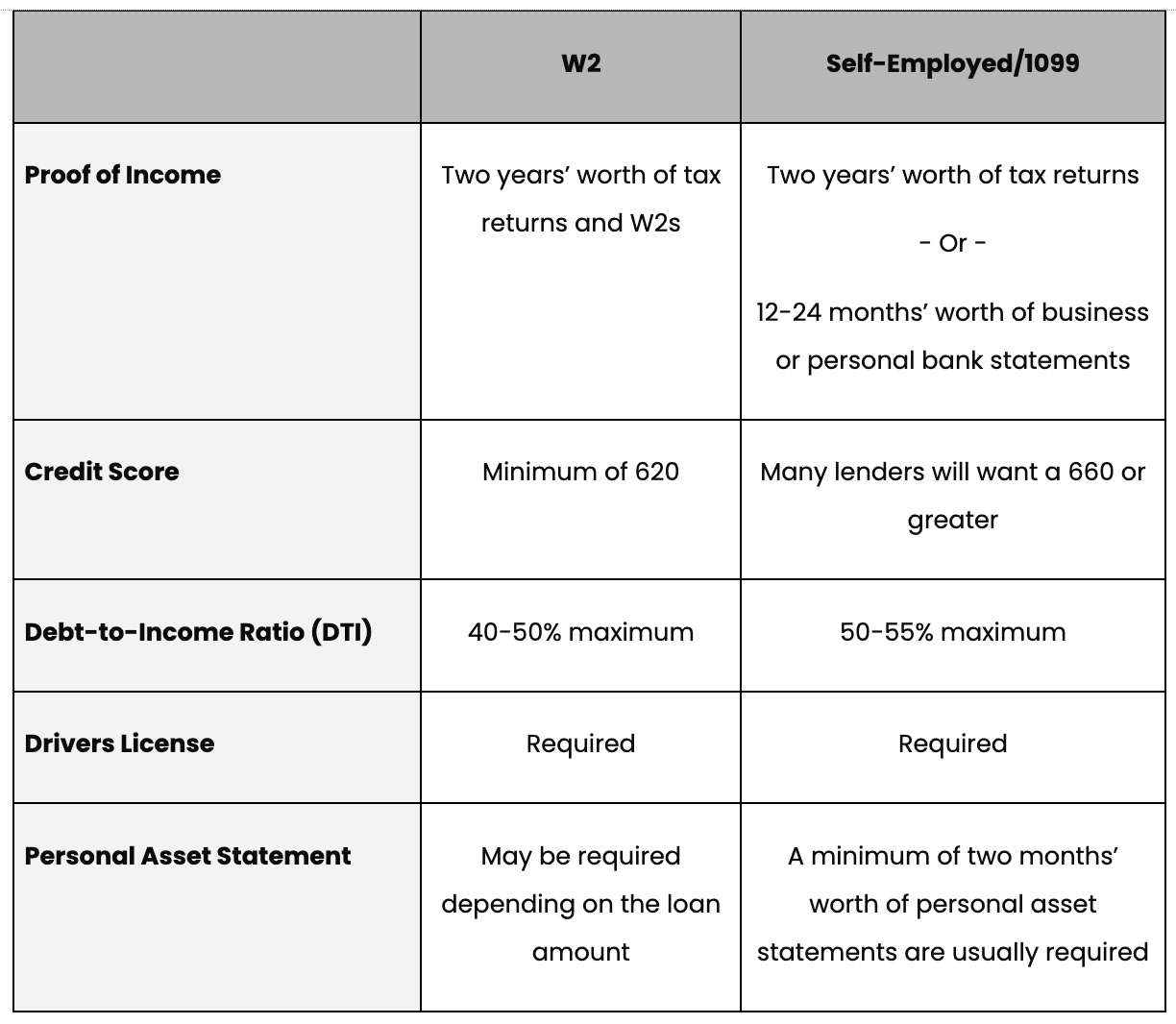
While the specific requirements may vary from lender to lender, typically, underwriting guidelines dictate that potential borrowers meet the following base criteria:
Special Considerations for Self-Employed Borrowers
Using the chart above, you can see some big differences between the requirements for each type of borrower. Keep in mind that lenders often group 1099 income with self-employment or independent contractor income for documentation purposes, but the exact treatment depends on the loan program and how your income is reported. For conventional loans, the Fannie Mae Selling Guide explains how lenders document income for self-employed borrowers.
The most important one is that self-employed individuals have the option to use bank statements to qualify for a mortgage. This is huge, considering that your tax returns most likely don't accurately reflect the actual income of your business.
To secure financing with your bank statements, lenders will typically do a very simple strategic cash analysis based on the cash flow that goes into your business bank account and couple it with a standard expense ratio.
Depending on how much cash comes into the business account every month, a portion of that amount (gross, not net) can typically be used as proof of income to qualify for your loan, with the exact percentage varying by lender and program.
You may also be asked for a CPA, tax preparer, or business verification letter confirming your ownership percentage and how long you have been self-employed. Exact documentation varies by loan program and lender. For agency-backed guidance on evaluating self-employment income, cite the current Fannie Mae and Freddie Mac seller guides, and for tax filing and transcript documentation, cite IRS records and forms.
For those of you that are newly self-employed, you'll have slightly more requirements you'll have to meet, but it's still possible for you to get a loan.
How to Maximize Your Borrowing Power as a 1099 Individual
To maximize your borrowing power when applying for a mortgage, self-employed individuals should take these steps:
Increase Your Credit Score: Your credit score is a direct indicator of your ability to manage your finances, so take every opportunity to get your score as high as possible.
Put together a Strong Financial Profile: To reassure lenders of your ability to repay the loan, gather a range of documents that clearly demonstrate your reliable and consistent income.
Save Extra Cash Reserves: Having extra cash stashed away for emergencies makes you a more attractive borrower to lenders because it showcases your financial responsibility and lessens the risk of defaulting on your loan.
Maintain Current Expense Documents: If your expenses are lower than the standard ratio used by your lender, then lenders can use your certified amount to calculate your loan amount.
Explore Your 1099 Mortgage Options With Modern Day Lending
When the time is right to explore your options, review our self-employed mortgage programs to see how bank statement and other alternative documentation loans may fit after a switch from W-2 to 1099 income.
With more than two decades of experience in the mortgage industry, our team understands how challenging it can be for entrepreneurs to secure a loan with competitive rates.
This is why we work hard to provide individualized solutions to your specific needs. Here's what you'll need to get the pre-approval process started:
12-24 months' worth of business or personal bank statements
CPA letter stating your percentage of ownership, length of self-employment, and your business's standing
Completed business questionnaire form
Two months' of personal asset statements
Driver's license
Ready to see how a recent switch from W-2 to 1099 affects your timeline? Talk with a mortgage specialist about your self-employed loan options and get a clear list of the documents your file may need.
Example: How a W-2 to 1099 Switch Can Change Qualifying Income
Here is a simplified example of why timing matters. A borrower earning a steady salary as a W-2 employee may qualify using pay stubs, W-2s, and year-to-date income. If that same borrower switches to 1099 work a few months before applying, the lender may need to document that the new income is stable and likely to continue.
In a traditional file, the underwriter may focus on current salary and employment history. In a 1099 or self-employed file, the review may shift to tax returns, 1099 forms, bank statements, business cash flow, expense ratios, and reserves. If tax write-offs reduce taxable income, a bank statement program may allow the lender to analyze deposits instead of relying only on net income shown on returns.
The key point is not that one path is better than the other. It is that a recent switch from W-2 to 1099 can change the documentation standard and the amount of income a lender is able to use.
Frequently Asked Questions
Can I get a mortgage after switching from W-2 to 1099?
Yes, a switch from W-2 to 1099 does not automatically prevent you from getting a mortgage. The main change is documentation. Instead of relying mostly on pay stubs and W-2s, the lender may need tax returns, 1099s, bank statements, or a CPA letter to verify that your income is stable and likely to continue.
How long do I need 1099 income to qualify for a mortgage?
It depends on the loan program and your full work history. Some borrowers need a longer self-employment history, while others may qualify with one year if they stayed in the same line of work and have strong compensating factors. The exact standard can vary by lender and program.
Can I use bank statements instead of tax returns?
In some non-QM programs, yes. Bank statement loans may let self-employed or 1099 borrowers qualify based on deposits rather than taxable income reported on returns. The lender still reviews consistency of deposits, business expenses, and overall ability to repay.
Will switching to 1099 reduce how much I can borrow?
It can. If the lender can use less of your income after the switch, your qualifying income may be lower than it was as a W-2 employee. That does not mean you cannot buy, only that the loan amount, documentation path, or timing of your application may need to change.