
How to Calculate Self-Employed Income for a Mortgage
Learn how to calculate self-employed income for a mortgage: the two-year averaging formula lenders use, a worked example, and the documents you'll need.

Here's how to calculate self-employed income for a mortgage: lenders usually add up the net income from your last two years of tax returns, divide the total by 24 to get a monthly average, and then compare that figure with your monthly debts. Many lenders also add back non-cash deductions such as depreciation, and bank statement programs use your deposits instead of your tax returns.
Below, we walk through the four steps lenders use, a worked example, how write-offs change your qualifying income, and the documents you'll need.
How to Calculate Self-Employed Income for a Mortgage
Most lenders start with your tax returns, average your qualifying income over two years, convert that figure to a monthly amount, and then test it against your monthly debts. Before you run the math, gather your last two years of returns, your current monthly debt payments, and any details about non-cash write-offs such as depreciation.
Step 1: Figure Out Your Average Annual Income
First, you'll need to figure out your average annual income. To do this, you add your past two years' earnings together and divide by two. On many conventional loans, this review is documented on a cash flow worksheet such as Fannie Mae Form 1084.
(Year 1 Earnings + Year 2 Earnings) / 2 = Average Annual Income
To obtain these figures, most lenders usually use your last two tax returns. If you've only been self-employed for one year, your lender will have additional documentation requirements you'll need to provide so they can determine your income.
Step 2: Calculate Your Average Monthly Income
This next step is pretty straightforward. You'll need to calculate your average monthly income, which you do by taking your average annual income and dividing it by 12.
Average Annual Income / 12 = Average Monthly Income
Step 3: Find Your Maximum Allowable Debt Per Month
Once you have your average monthly income, you'll need to find your maximum allowable debt per month.
To get this figure, lenders will use a standard debt-to-income ratio (DTI) and multiply it by your average monthly income. It will allow them to determine how much you can afford to pay (including your expenses and mortgage).
The Consumer Financial Protection Bureau notes that different loan products and lenders have different DTI limits. On conventional loans, Fannie Mae caps total DTI at 36% for manually underwritten loans, or up to 45% with strong credit and reserves, and at 50% for loans approved through its Desktop Underwriter system. The worked example below uses a conservative 36%, so ask your loan officer which limit applies to your file.
(Average Monthly Income x DTI) = Maximum Allowable Debt per Month
Step 4: Determine Your Maximum Mortgage Payment
Many people stop at the last step, but that number isn't an accurate representation of your mortgage payment, it's your total allowable debt which includes your monthly expenses.
Now, it's time to take them back out to get a better picture of your actual allowable mortgage payment. To do this, you'll subtract your existing monthly expenses from your maximum allowable debt per month.
Maximum Allowable Debt per Month - Existing Expenses = Maximum Mortgage Payment
Example
Okay, now that you know the process for the calculation, let's run through an example.
For this demonstration, we'll pretend the first year's earnings were $75,000, the second year's earnings were $100,000, and the current monthly expenses are $700. We'll also use a 36% DTI for our calculation.
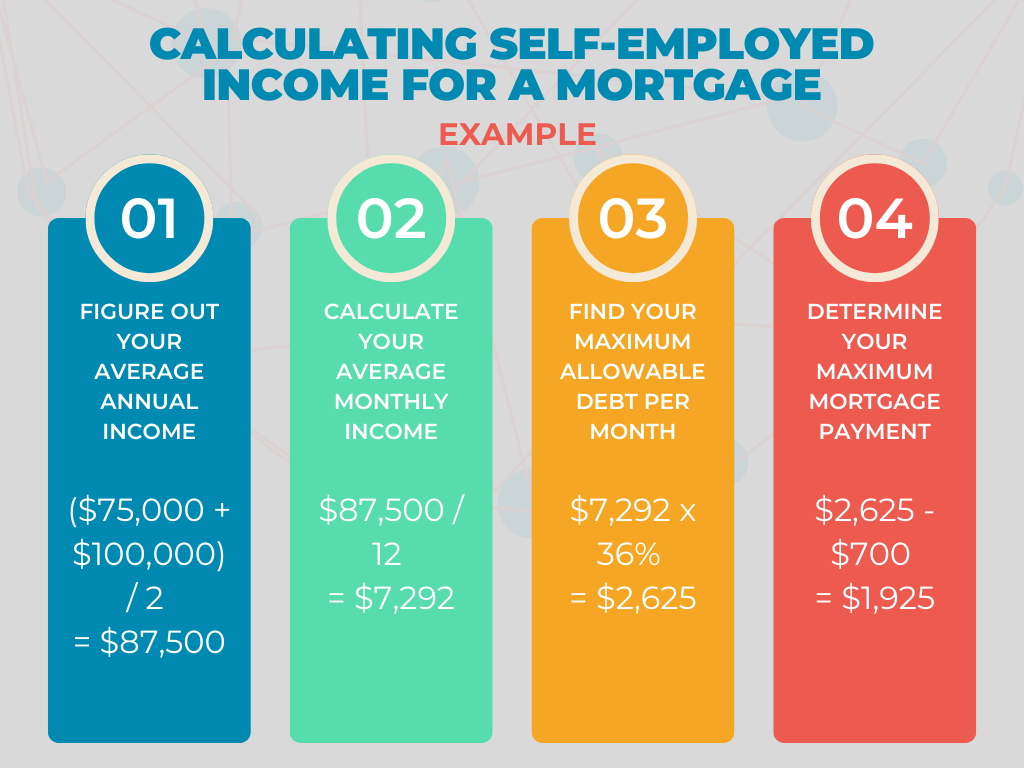
Using these figures, you'll see that the maximum mortgage payment will be around $1,925.
Now consider how write-offs can change the result. If your two-year average taxable income is lower because you claimed depreciation or another eligible non-cash expense, a lender may be able to add some of that amount back when calculating qualifying income. That is why two borrowers with the same gross revenue can end up with very different mortgage numbers on paper.
While this calculation will get you a ballpark estimate, it's essential to keep in mind that these figures are subject to change. You should speak with a mortgage professional to get an accurate estimate of what you can afford.
How Will My Self-Employment Income Be Used in the Mortgage Approval Process?
One of the most important things that lenders will look at when considering your mortgage application is your income. Lenders want to know how much money you're bringing in and whether that income will continue.
Lenders do not all use the same income method. Many start with your net, taxable income from your returns, then adjust it with any allowed add-backs. Others may use an alternative documentation program, such as bank statements, when that better reflects your cash flow.
Typically, they'll use the net income you reported on your tax returns since that gives them an idea of your income consistency over the years.
However, for self-employed individuals who like to take advantage of write-offs, this can be a major problem.
There are other methods of assessing your income, including looking at your bank statements, using financial statements from your business, and others, but that will depend on your lender and their guidelines.
For example, a bank statement loan usually starts with 12 to 24 months of deposits rather than taxable income on your returns. The lender then applies an expense factor, or uses a documented business expense ratio, to estimate the monthly income available to support the mortgage.
If you can, reach out to your lender and ask which type of income they will use to qualify you for the loan. By knowing which method your lender is likely to use, you can be better prepared with the required documentation.
This will help make the loan approval process go smoothly and increase your chances of getting approved for the loan.
Where Lenders Usually Pull Self-Employed Income From
| Borrower type | Common tax form | What lenders usually review first |
|---|---|---|
| Sole proprietor | Schedule C, Form 1040 | Net profit, then any eligible add-backs such as depreciation |
| Partnership | Form 1065 and K-1 | Your share of business income, plus any qualifying add-backs and liquidity review |
| S corporation owner | Form 1120S and K-1 | K-1 income, W-2 wages paid by the business if applicable, and business cash flow |
| C corporation owner | Form 1120 | Salary or draws, plus a review of business earnings when required |
| 1099 contractor | 1099s, often with Schedule C | Reported income, related expenses, and whether tax returns or an alternative program will be used |
The exact worksheet depends on the loan program and how your business is structured. On conventional loans, lenders often complete a cash flow analysis using Fannie Mae Form 1084 or a similar internal worksheet.
What Documents Do I Need to Prove My Self-Employment Income?
When you're self-employed, you need to bring a few extra things to the table when applying for a mortgage.
While these requirements may fluctuate depending on your lender and the type of loan you choose, here's what the majority of lenders will need from you:
Tax Returns: You'll need two years' worth of tax returns to show your income. These will be one of the most important documents lenders will need to determine how much they're willing to lend you.
Bank Statements: If your lender opts to use your gross income, you'll typically need several months to two years' worth of bank statements (business or personal), so they can get an idea of the cash flow of your business. They'll be looking for consistent income and not a lot of fluctuation month to month.
CPA Letter: Some lenders ask for a CPA, tax preparer, or licensing letter to confirm business ownership, good standing, and how long you've been self-employed. Whether this is required depends on the loan program and the rest of your file.
Business Questionnaire Form: Loan officers use this form to understand specific details about prospective homebuyers, the properties they're interested in, and the ability to repay their mortgages.
Your Driver's License: This is just a formality, but you'll need to show that you're who you say you are.
Frequently Asked Questions
Do lenders use a calculator or a manual worksheet to figure self-employed income?
Many conventional loans are underwritten using a cash flow analysis worksheet, often referred to by its Fannie Mae form number, Form 1084, which walks through the same averaging and add-back logic described above. Some lenders use their own version of a self-employment income calculator built on the same underlying method, but the steps in this post reflect the core logic behind most of them.
What are income add-backs, and can they help me qualify?
Add-backs are certain non-cash or one-time expenses on your tax returns, such as depreciation, depletion, or a documented one-time business loss, that a lender may add back to your net income because they don't reflect money that actually left your business. Ask your loan officer which add-backs they allow, since this varies by loan program and can meaningfully raise the income figure used to qualify you.
Why does the two-year average matter so much?
Lenders average two years of income rather than using your most recent year alone because it smooths out normal fluctuations in self-employment earnings and shows whether your income trend is stable, increasing, or declining. A significant year-over-year decline can prompt extra questions even if your two-year average looks strong on paper.
What to Do Next if You're Self-Employed
If your tax returns show strong net income, a standard mortgage may already work. If heavy write-offs reduce your qualifying income, ask whether a lender can use eligible add-backs or whether a bank statement program would better reflect your cash flow.
Before you apply, gather your last two years of tax returns, recent bank statements, and a list of monthly debts. Then compare your options with a lender that handles self-employed mortgage programs so you know which income method fits your file.