
How Does a HELOC Work for Self-Employed Borrowers?
How a HELOC works, its draw and repayment periods, and what self-employed borrowers need to qualify, in plain English.

How does a HELOC work for self-employed borrowers? The same way it works for any homeowner. A home equity line of credit (HELOC) lets you borrow against your home's equity as needed instead of taking one lump sum: you get an approved credit line, draw from it during the draw period, then repay principal and interest during the repayment period.
The main difference is qualification. Instead of W-2s and pay stubs, self-employed applicants usually document income with tax returns, profit and loss statements, or bank statements, depending on the lender and program. Below, we'll walk through how a HELOC works, how lenders calculate available equity, and what self-employed borrowers should expect during underwriting.
What Is a Home Equity Line Of Credit (HELOC)?
A home equity line of credit, or HELOC, is a type of secured loan that allows homeowners to borrow money using the equity in their home as collateral. It's a useful way for homeowners to access funds for:
Large home expenses, such as renovations, repairs, or new purchases
Consolidating debt
Covering other financial needs, such as college tuition
To determine equity, lenders calculate the difference between your home's value and the amount you still owe on your mortgage.
For example, if your home is worth $400,000 and your mortgage balance is $250,000, you have $150,000 in equity. You usually cannot borrow all of that equity. The lender sets a maximum combined loan-to-value limit, then subtracts your current mortgage balance to estimate how much of a HELOC may be available.
Here is what that can look like in practice: if you are approved for a $60,000 HELOC, you do not receive $60,000 all at once. If you draw $15,000 for a renovation, you generally pay interest only on that $15,000 during the draw period, subject to your lender's terms. If you later draw another $10,000, your balance and payment can increase. Once the repayment period begins, the payment usually rises because you are paying back principal and interest, not just interest.
How Exactly Does a HELOC Work?
Unlike traditional loans, where lenders give borrowers a lump sum of money to cover the costs of what they need, a HELOC works more like a credit card, where the homeowner borrows money (up to a certain limit) and pays it back over time, with interest.
So if we go back to that example from above, the homeowner may have access to a credit line based on their available equity; however, they don't have to use the full amount, nor are those funds automatically distributed into their account.
Instead, this type of loan is broken down into two distinct periods: Draw and Repayment.
The Draw Period
The "draw period" is when homeowners borrow money from their HELOC. It usually lasts for a set number of years (commonly around ten, though this varies by lender), and during this time, they withdraw funds as needed, up to the maximum amount of the credit line.
Homeowners access the funds from their HELOC in several ways, such as:
Writing checks
Using a credit card
Accessing the funds electronically
During the draw period, homeowners are typically only required to pay interest on the amount of money they borrow, and they can pay back the funds as quickly or as slowly as they want, as long as they remain within the credit limit.
The Repayment Period
The "repayment period" is when homeowners are required to repay the borrowed money. Depending on the lender, it begins after the draw period and can last several years.
During the repayment period, borrowers will be required to make regular payments that include both principal and interest. However, some HELOCs have the option to pay off the entire loan balance at once.
This can be a convenient way to pay off your HELOC quickly, but it may require you to pay a higher interest rate or additional fees. It's important to carefully consider your options and choose the right repayment option for your financial situation.
Interest Rates
HELOC interest rates are usually variable, so they change over time depending on the market. This is because they are commonly tied to a financial index, such as the prime rate published by the Federal Reserve.
As the prime rate changes, so does the interest rate on a HELOC, meaning the amount of interest homeowners pay on their HELOC can vary from month to month. So it's important to be prepared for potential rate changes.
Some HELOCs have a "cap" or "ceiling" on the interest rate, which means the rate cannot rise above a certain level.
While this provides some protection against large increases in the interest rate, it can also mean that homeowners may not be able to benefit from any decreases in the interest rate.
What Are the Pros and Cons of a Home Equity Line of Credit?
While a HELOC is not right for everyone, it can be a useful financial tool for accessing funds and managing your finances. It's important to carefully consider the advantages and disadvantages of a HELOC before taking out a loan.
Advantages:
Convenient Access to Funds: A HELOC provides access to a line of credit that you can tap into as needed, making it useful for unexpected expenses or financing larger purchases.
Flexibility: With a HELOC, you can borrow as much or as little as you need, up to your credit limit.
Minimize Interest: You only have to pay interest on the money you borrow versus a large lump sum. Additionally, if you consolidate your high-interest debt, you may save money on interest payments, depending on your rate and terms.
Disadvantages:
Overborrowing: Because a HELOC allows you to borrow money as needed, up to the maximum amount of your credit line, it's easy to borrow more than you can afford to repay, leading to financial difficulties.
Foreclosure: Since you're using your home as collateral, your lender can foreclose on your home and take possession of it if you don't make your payments. The Consumer Financial Protection Bureau notes this risk applies to any loan secured by your home.
Variable Interest Rates: The amount of interest you pay on your HELOC can vary from month to month, and it may be higher than the interest rate on other types of loans, such as a personal loan or a fixed-rate mortgage.
HELOC vs. Equity Loans vs. Refinancing
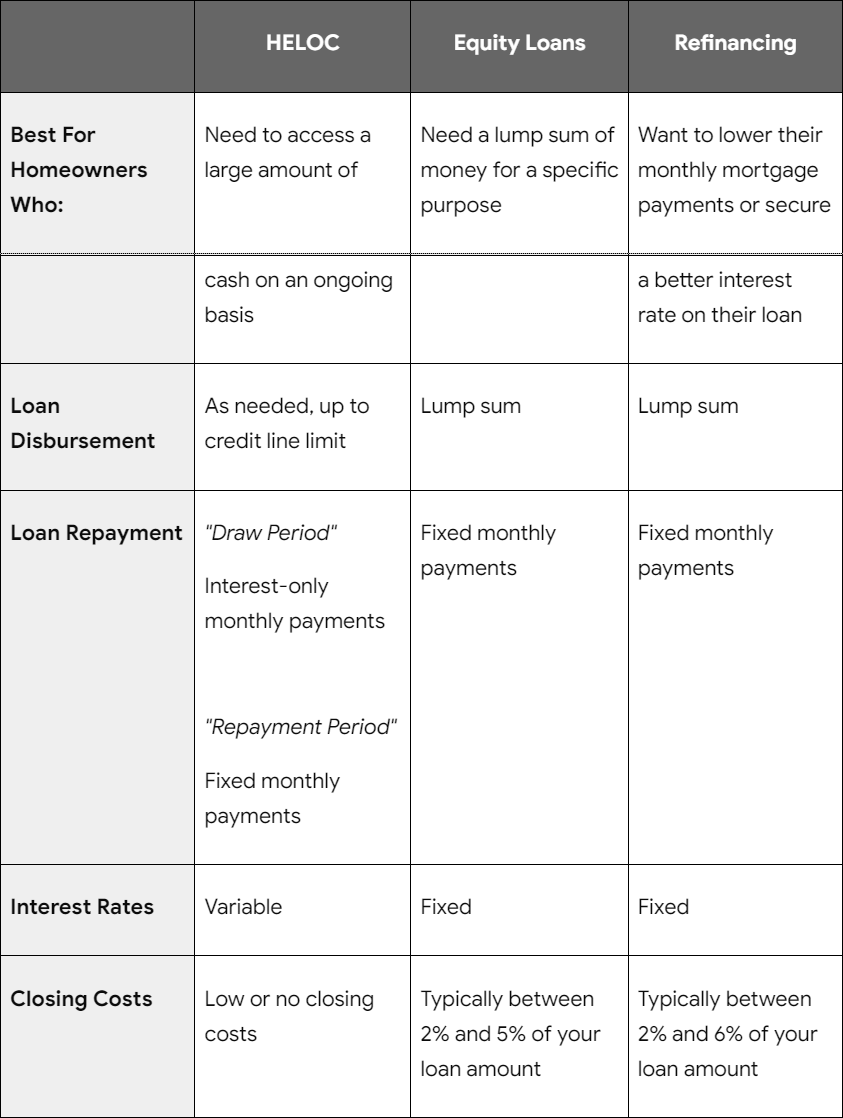
While HELOC, equity loans, and refinancing are all forms of borrowing that can be used to tap into the equity that a homeowner has built up in their property, they each have different terms that make them distinct products.
This chart gives you a better idea of how they stack up side-by-side:
How Do You Qualify for a HELOC?
The specific qualification requirements for a HELOC will vary depending on the lender and the specific terms of the loan. However, some common qualification factors for a HELOC include:
Ownership/Equity: While this might seem like a no-brainer, you must own your home and have sufficient equity before applying. The amount of equity required varies by lender.
Proof of Income: Lenders want to see you've got a steady source of income, which you can prove through tax returns, paychecks, and bank statements.
Credit Score: Lenders set their own minimum credit score requirements for a HELOC, and these can vary by lender and loan program. Check with your lender for current requirements.
Debt-to-Income Ratio (DTI): Lenders evaluate your DTI as part of underwriting, and acceptable limits vary by lender and loan program.
If you're ready to apply for a HELOC, we recommend the following steps:
Research and compare different lenders to find one that offers a HELOC with terms and rates that are favorable to you.
Contact the lender via website, phone, or in person, and express your interest in applying for a HELOC.
Provide the lender with the necessary information and documentation.
The lender will review your application and, if approved, will provide you with a credit limit and terms for your HELOC.
Once you have received your credit limit and terms, you can begin using your HELOC to borrow money, as needed, up to your credit limit.
It's important to carefully consider your financial situation before applying for a HELOC and ensure you understand the terms of your HELOC, including the interest rate and repayment terms, before agreeing to anything.
How Does a HELOC Work for Self-Employed Borrowers?
Self-employed borrowers can qualify for a HELOC, but the income documentation looks different than it does for a salaried employee. Instead of pay stubs, a lender typically asks for one or more of the following:
Two years of personal and business tax returns, which most lenders use to calculate a qualifying income average.
Profit and loss statements for the current year, especially if your latest tax return doesn't fully reflect your business's income.
Personal or business bank statements as an alternative to tax returns. Some lenders offer "bank statement" programs that estimate income from deposit history instead of tax filings, which can help borrowers whose tax returns show heavy deductions.
Because self-employment income can look inconsistent on paper even when the business is healthy, it's worth asking a prospective lender directly how they document income and calculate DTI for self-employed applicants before you apply. Requirements and available programs vary by lender.
What Lenders Usually Review on a Self-Employed HELOC
Each lender sets its own HELOC guidelines, but many review self-employed income the way a first mortgage underwriter would, and Fannie Mae's self-employed underwriting guidelines are a common reference point. Expect questions on these factors:
Time in business: two years of self-employment is the usual benchmark, though some lenders accept one year when you have a strong history in the same line of work.
Income trend: steady or rising net income is easier to approve than income that fell from one year to the next.
Documentation type: full-documentation files rely on tax returns, while alternative programs may use 12 to 24 months of bank statements or a CPA-prepared profit and loss statement.
Debt-to-income ratio: the new HELOC payment is added to your existing monthly debts, and the total has to fit the lender's limit.
Combined loan-to-value: your first mortgage balance plus the full HELOC limit, compared with your home's appraised value.
Credit and reserves: your credit score and the cash you have left after closing both shape the rate and line size you're offered.
Here's why the documentation type matters. Say a consultant deposits about $12,000 a month, but business write-offs bring the net income on their tax returns down to $48,000 a year, or $4,000 a month. A lender working from tax returns qualifies them on $4,000 a month. A bank statement program that applies a 50% expense factor to the same deposits would count about $6,000 a month, and that gap can decide whether the HELOC payment fits within the lender's DTI limit.
Frequently Asked Questions
Can a self-employed borrower get a HELOC without traditional income verification?
Some lenders offer alternative documentation options, such as bank statement programs, for self-employed borrowers who don't have traditional pay stubs or W-2s. Availability and terms vary by lender, so confirm what a specific lender accepts before applying.
What's the difference between a HELOC and a home equity loan?
A home equity loan disburses a lump sum upfront with a fixed rate and fixed payments, while a HELOC gives you a revolving line of credit you draw from as needed, typically with a variable rate. The comparison chart above breaks down the key differences.
How does a HELOC affect my debt-to-income ratio?
Lenders generally count your HELOC payment, or a portion of your available credit line, toward your overall debt-to-income ratio during underwriting. Acceptable DTI limits vary by lender and loan program.
How much equity do you need for a HELOC?
Most lenders cap your combined loan-to-value (CLTV) ratio, which is your first mortgage plus the full HELOC limit divided by your home's value. Caps of 80% to 90% are common. For example, on a $500,000 home with an 85% CLTV cap, total borrowing can reach $425,000, so if you owe $300,000 on your first mortgage, the largest HELOC limit would be about $125,000. The exact cap depends on the lender, program, property type, and your credit profile.
Uncover Your Best Mortgage Options with Modern Day Lending
As online lending continues to expand and alternative loan products become more available, navigating the mortgage market has become increasingly complex, leaving borrowers feeling overwhelmed.
Luckily, there's Modern Day Lending. We take all the guesswork out of searching for the right loan options for you and make it easy to quickly compare different loan options.
Whether you're looking for a traditional mortgage, a HELOC, or another asset-based loan, we can help you find the right loan product to suit your needs and budget.
Reach out to speak with one of our loan specialists to see what options are available to you.